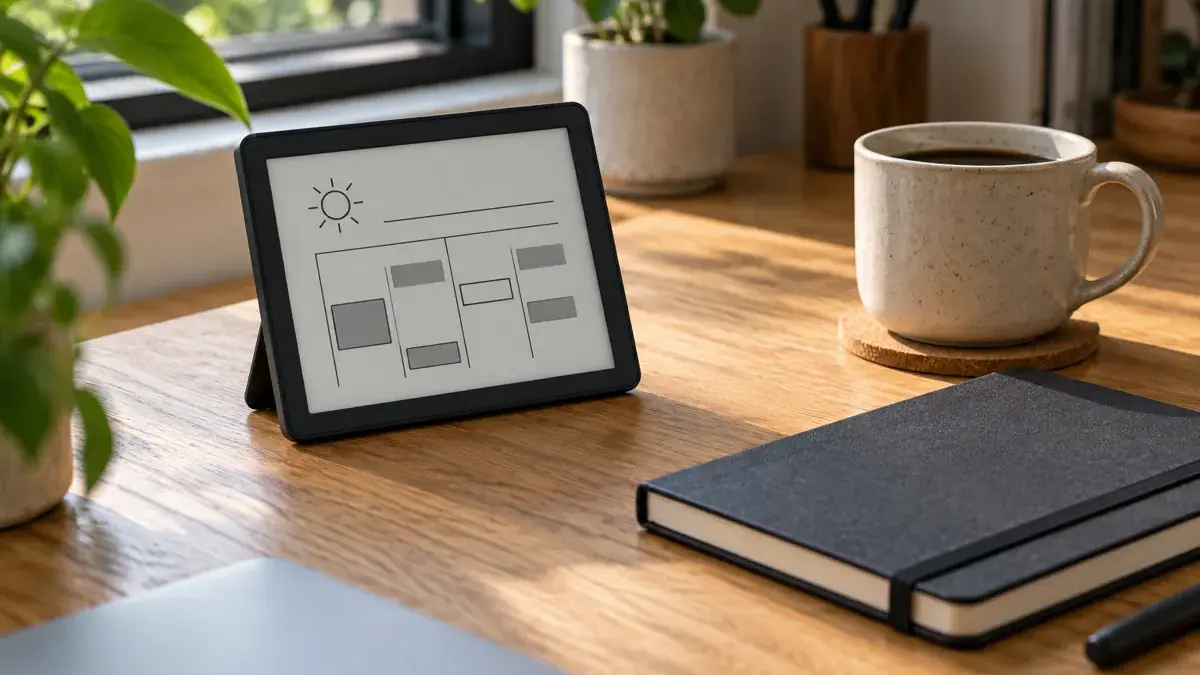
A screen does not always need to behave like a video player. For a timetable, room label, or quiet desk dashboard, keeping information visible can matter more than changing it continuously.
Why an image can stay visible
E Ink's technology explanation describes electrophoretic displays, in which electrical fields move pigment particles to change the visible image.
Its benefits guide describes bistability: the display can retain an updated image without power being used to maintain that image.
That statement concerns the display behaviour. A complete device can still consume power through its processor, connectivity, lighting, sensors, and other components.
Design around the information lifetime
Imagine a hypothetical desk panel showing today's appointments and a build status. Updating only when those details change is a different workload from continuously animating a chat transcript.
Our design suggestion is to list each field, its acceptable age, and the event that should refresh it. An appointment title might need a change event; a clock display introduces a different update requirement.
The screen choice follows the information contract rather than the other way around.
A retained image can also be stale
A panel that continues showing a previous result needs a way to communicate whether the data is current. We recommend including a last-update indicator and an obvious stale-data state.
For example, a network failure should not leave yesterday's successful build looking like today's status. This is an application-design requirement, not a property the display automatically supplies.
Check the actual panel
E Ink's technology FAQ discusses product and update considerations. Colour capability, refresh modes, and operating conditions vary by module.
Do not transfer a specification from one display family to another. Record the exact panel, controller, refresh behaviour, and power measurements for the device being considered.
For a prototype, measure a complete cycle: waking, connecting, retrieving data, drawing the screen, and returning to its resting state. The full cycle tells a more useful energy story than the panel's image-retention property alone.
Choose a restrained interface
Our proposed dashboard layout uses a few large fields with explicit labels and a visible update time. Keep essential information readable at the expected viewing distance.
Electronic paper is an interesting option when the product benefits from persistent, readable information. The strongest use case begins with what the user needs to glance at, not with a miniature version of a busy phone screen.
For processing close to the device, see Edge Computing Close to the Source.
Cover: original AI-generated product illustration.